


DRF 视图扩展类
【一】5个视图扩展类
- GenericAPIView + 5个视图扩展类 + 序列化类 + Response写接口
【1】5个视图扩展类对应五个方法
- 查询所有数据
- 新增一条数据
- 查询单条数据
- 修改一条数据
- 删除一条数据
【2】写5个类的好处就是
-
解耦合,提高代码的可扩展性
-
这五个类不叫视图类,叫视图扩展类,需要配合GenericAPIView一起用
-
每个类有一个方法,以后想写哪个接口,就继承哪个类即可
【3】5个视图扩展类
-
ListModelMixin:查询所有数据(list方法)class ListModelMixin:def list(self, request, *args, **kwargs):qs = self.get_queryset()ser = self.get_serializer(qs, many=True)return Response({'code': 100, 'msg': '成功', 'results': ser.data}) -
CreateModelMixin:新增一条数据(create方法)class CreateModelMixin:def create(self, request, *args, **kwargs):ser = self.get_serializer(data=request.data)if ser.is_valid():ser.save()return Response({'code': 100, 'msg': '成功'})else:return Response({'code': 100, 'msg': ser.errors}) -
RetrieveModelMixin:查询单条数据(retrieve方法)class RetrieveModelMixin:def retrieve(self, request, *args, **kwargs):book = self.get_object()ser = self.get_serializer(book)return Response({'code': 100, 'msg': '成功', 'results': ser.data}) -
DestroyModelMixin:删除一条数据(destroy方法)class DestroyModelMixin:def destroy(self, request, *args, **kwargs):self.get_object().delete()return Response({'code': 100, 'msg': '删除成功'}) -
UpdateModelMixin:修改一条数据(update方法)class UpdateModelMixin:def update(self, request, *args, **kwargs):book = self.get_object()ser = self.get_serializer(data=request.data, instance=book)if ser.is_valid():ser.save()return Response({'code': 100, 'msg': '更新成功'})else:return Response({'code': 100, 'msg': ser.errors})
【4】演示
class BookView(GenericAPIView, ListModelMixin, CreateModelMixin): queryset = Book.objects.all() serializer_class = BookSerialzier
def get(self, request): return self.list(request)
def post(self, request): return self.create(request)-
上述代码定义了一个名为
BookView的类,该类继承自GenericAPIView、ListModelMixin和CreateModelMixin三个类。-
GenericAPIView是Django REST Framework提供的通用视图类,它提供了一些常用的REST操作的实现,如GET、POST、PUT、DELETE等,并对请求进行了封装,使得编写视图变得更加简洁和易读。 -
ListModelMixin是一个Mixin类,它提供了列表视图(获取多个对象)的具体实现,包括处理GET请求和返回序列化后的数据列表。 -
CreateModelMixin也是一个Mixin类,它提供了创建视图(新建对象)的具体实现,包括处理POST请求和返回序列化后的新建对象数据。
-
-
在
BookView类中,我们还定义了以下属性和方法:-
queryset:指定了查询集,即要进行操作的对象集合。这里使用Book.objects.all()表示查询所有的Book对象。 -
serializer_class:指定了用于序列化和反序列化的序列化器类,这里使用BookSerializer。 -
get(self, request)方法:处理GET请求,调用父类list方法返回序列化后的数据列表。 -
post(self, request)方法:处理POST请求,调用父类create方法创建新的对象并返回序列化后的数据。
-
-
通过上述代码,我们可以基于
BookView类创建一个API视图,支持获取书籍列表和创建新的书籍对象的操作。- 当我们发送GET请求时,将返回所有书籍的序列化数据列表;
- 当我们发送POST请求时,将根据请求的参数创建一个新的书籍对象,并返回该对象的序列化数据。
-
总结起来,上述代码展示了使用DRF编写API视图的常见用法:
- 使用Mixin类继承和基于通用视图类进行开发,从而简化了代码的编写,提高了开发效率。
- 同时,通过配置查询集和序列化器类,我们可以指定对应的数据模型和序列化逻辑,实现对数据的获取和创建操作。
class BookDetailView(GenericAPIView, RetrieveModelMixin, UpdateModelMixin, DestroyModelMixin): queryset = Book.objects.all() serializer_class = BookSerialzier
def get(self, request, *args, **kwargs): return self.retrieve(request, *args, **kwargs)
def put(self, request, *args, **kwargs): return self.update(request, *args, **kwargs)
def delete(self, request, *args, **kwargs): return self.destroy(request, *args, **kwargs)-
上述代码定义了一个名为
BookDetailView的类,该类继承自GenericAPIView、RetrieveModelMixin、UpdateModelMixin和DestroyModelMixin四个类。-
GenericAPIView是Django REST Framework提供的通用视图类,它提供了一些常用的REST操作的实现,如GET、POST、PUT、DELETE等,并对请求进行了封装,使得编写视图变得更加简洁和易读。 -
RetrieveModelMixin是一个Mixin类,它提供了获取单个对象的具体实现,包括处理GET请求和返回序列化后的对象数据。 -
UpdateModelMixin是一个Mixin类,它提供了更新对象的具体实现,包括处理PUT请求和返回更新后的对象数据。 -
DestroyModelMixin是一个Mixin类,它提供了删除对象的具体实现,包括处理DELETE请求和返回删除成功的响应。
-
-
在
BookDetailView类中,我们同样定义了queryset和serializer_class属性,用于指定操作的查询集和序列化器类。 -
此外,我们还重写了以下方法:
-
get(self, request, *args, **kwargs)方法:- 处理GET请求,调用父类的
retrieve方法来获取指定对象的序列化数据并返回。
- 处理GET请求,调用父类的
-
put(self, request, *args, **kwargs)方法:- 处理PUT请求,调用父类的
update方法来更新指定对象并返回更新后的序列化数据。
- 处理PUT请求,调用父类的
-
delete(self, request, *args, **kwargs)方法:- 处理DELETE请求,调用父类的
destroy方法来删除指定对象并返回删除成功的响应。
- 处理DELETE请求,调用父类的
-
-
通过上述代码,我们可以基于
BookDetailView类创建一个API视图,- 支持获取特定书籍对象
- 更新特定书籍对象
- 删除特定书籍对象的操作
-
当我们发送GET请求时
- 将返回指定书籍对象的序列化数据;
- 当我们发送PUT请求时,将更新指定书籍对象的字段,并返回更新后的序列化数据;
- 当我们发送DELETE请求时,将删除指定书籍对象,并返回删除成功的响应。
【5】小结
-
5个视图扩展类--->不是视图类--->必须配合GenericAPIView及其子类使用--->不能配合APIView使用
-
5个视图扩展类,每一个类中只有一个方法,完成5个接口中的其中一个,想写多个接口,就要继承多个
【二】9个视图子类
- 基于视图子类写接口: 9个视图子类 ---> 视图类
【推导】
【1】原始办法
from rest_framework.mixins import ListModelMixin, CreateModelMixinfrom rest_framework.generics import GenericAPIView, ListAPIView, CreateAPIView, ListCreateAPIView
class BookView(GenericAPIView, ListModelMixin, CreateModelMixin): queryset = Book.objects.all() serializer_class = BookSerializer
def get(self, request): return self.list(request)
def post(self, request): return self.create(request)【2】基于视图子类
from rest_framework.mixins import ListModelMixin, CreateModelMixinfrom rest_framework.generics import GenericAPIView, ListAPIView, CreateAPIView, ListCreateAPIView
class ListAPIView(GenericAPIView, ListModelMixin): def get(self, request): return self.list(request)
class CreateAPIView(GenericAPIView, CreateModelMixin): def post(self, request): return self.create(request)
class ListCreateAPIView(GenericAPIView, ListModelMixin, CreateModelMixin): def get(self, request): return self.list(request)
def post(self, request): return self.create(request)- 查询所有
class BookView(ListAPIView): queryset = Book.objects.all() serializer_class = BookSerializer- 新增数据
class CreateAPIView(ListAPIView): queryset = Book.objects.all() serializer_class = BookSerializer- 既查询所有又新增数据
class ListCreateAPIView(ListAPIView): queryset = Book.objects.all() serializer_class = BookSerializer【基于DRF】
from rest_framework.generics import ListAPIView, CreateAPIView, DestroyAPIView, UpdateAPIView, RetrieveAPIViewfrom rest_framework.generics import ListCreateAPIViewfrom rest_framework.generics import RetrieveUpdateDestroyAPIViewfrom rest_framework.generics import RetrieveDestroyAPIViewfrom rest_framework.generics import RetrieveUpdateAPIViewfrom rest_framework.generics import UpdateDestroyAPIView# 没有这个视图 : 更新删除的前提是有数据,即先查询【三】视图集
【1】视图集导入
from rest_framework.viewsets import ModelViewSet【2】视图函数
- 继承视图集后,只需要在视图类中写两行
queryset = 模型表名.objects.all()serializer_class = 自定义序列化类【3】路由格式
path('books/', BookView.as_view({'get': 'list', 'post': 'create'})),path('books/<int:pk>/', BookView.as_view({'get': 'retrieve', 'put': 'update', 'delete': 'destroy'})),- 路由中必须根据请求指定触发的函数方法
【4】ModelViewSet 源码分析
class ModelViewSet(mixins.CreateModelMixin, mixins.RetrieveModelMixin, mixins.UpdateModelMixin, mixins.DestroyModelMixin, mixins.ListModelMixin, GenericViewSet): """ A viewset that provides default `create()`, `retrieve()`, `update()`, `partial_update()`, `destroy()` and `list()` actions. """ pass-
ModelViewSet 继承了
-
mixins.CreateModelMixin -
mixins.RetrieveModelMixin -
mixins.UpdateModelMixin -
mixins.DestroyModelMixin -
mixins.ListModelMixin -
GenericViewSet
-
-
GenericViewSet源码分析,继承了ViewSetMixingenerics.GenericAPIView
class GenericViewSet(ViewSetMixin, generics.GenericAPIView): """ The GenericViewSet class does not provide any actions by default, but does include the base set of generic view behavior, such as the `get_object` and `get_queryset` methods. """ pass(1)继承了ModelViewSet,路由需要指定格式的原因
-
只要继承了ModelViewSet,路由写法变了,谁控制它变的:ViewSetMixin
-
ViewSetMixin源码分析- 根据这句话,我们就可以直观的发现我们需要指定路由格式的原因
"""This is the magic.Overrides `.as_view()` so that it takes an `actions` keyword that performsthe binding of HTTP methods to actions on the Resource.For example, to create a concrete view binding the 'GET' and 'POST' methodsto the 'list' and 'create' actions...view = MyViewSet.as_view({'get': 'list', 'post': 'create'})"""这是一个魔法。覆写 `.as_view()` 方法,使其接受一个 `actions` 关键字参数,用于将 HTTP 方法绑定到资源的动作(action)上。例如,要创建一个具体的视图,并将 'GET' 和 'POST' 方法绑定到 'list' 和 'create' 动作上...```view = MyViewSet.as_view({'get': 'list', 'post': 'create'})```
class ViewSetMixin: """ This is the magic.
Overrides `.as_view()` so that it takes an `actions` keyword that performs the binding of HTTP methods to actions on the Resource.
For example, to create a concrete view binding the 'GET' and 'POST' methods to the 'list' and 'create' actions...
view = MyViewSet.as_view({'get': 'list', 'post': 'create'}) """
@classonlymethod def as_view(cls, actions=None, **initkwargs): """ Because of the way class based views create a closure around the instantiated view, we need to totally reimplement `.as_view`, and slightly modify the view function that is created and returned. """ # The name and description initkwargs may be explicitly overridden for # certain route configurations. eg, names of extra actions. cls.name = None cls.description = None
# The suffix initkwarg is reserved for displaying the viewset type. # This initkwarg should have no effect if the name is provided. # eg. 'List' or 'Instance'. cls.suffix = None
# The detail initkwarg is reserved for introspecting the viewset type. cls.detail = None
# Setting a basename allows a view to reverse its action urls. This # value is provided by the router through the initkwargs. cls.basename = None
# actions must not be empty if not actions: raise TypeError("The `actions` argument must be provided when " "calling `.as_view()` on a ViewSet. For example " "`.as_view({'get': 'list'})`")
# sanitize keyword arguments for key in initkwargs: if key in cls.http_method_names: raise TypeError("You tried to pass in the %s method name as a " "keyword argument to %s(). Don't do that." % (key, cls.__name__)) if not hasattr(cls, key): raise TypeError("%s() received an invalid keyword %r" % ( cls.__name__, key))
# name and suffix are mutually exclusive if 'name' in initkwargs and 'suffix' in initkwargs: raise TypeError("%s() received both `name` and `suffix`, which are " "mutually exclusive arguments." % (cls.__name__))
def view(request, *args, **kwargs): self = cls(**initkwargs)
if 'get' in actions and 'head' not in actions: actions['head'] = actions['get']
# We also store the mapping of request methods to actions, # so that we can later set the action attribute. # eg. `self.action = 'list'` on an incoming GET request. self.action_map = actions
# Bind methods to actions # This is the bit that's different to a standard view for method, action in actions.items(): handler = getattr(self, action) setattr(self, method, handler)
self.request = request self.args = args self.kwargs = kwargs
# And continue as usual return self.dispatch(request, *args, **kwargs)
# take name and docstring from class update_wrapper(view, cls, updated=())
# and possible attributes set by decorators # like csrf_exempt from dispatch update_wrapper(view, cls.dispatch, assigned=())
# We need to set these on the view function, so that breadcrumb # generation can pick out these bits of information from a # resolved URL. view.cls = cls view.initkwargs = initkwargs view.actions = actions return csrf_exempt(view)
def initialize_request(self, request, *args, **kwargs): """ Set the `.action` attribute on the view, depending on the request method. """ request = super().initialize_request(request, *args, **kwargs) method = request.method.lower() if method == 'options': # This is a special case as we always provide handling for the # options method in the base `View` class. # Unlike the other explicitly defined actions, 'metadata' is implicit. self.action = 'metadata' else: self.action = self.action_map.get(method) return request
def reverse_action(self, url_name, *args, **kwargs): """ Reverse the action for the given `url_name`. """ url_name = '%s-%s' % (self.basename, url_name) namespace = None if self.request and self.request.resolver_match: namespace = self.request.resolver_match.namespace if namespace: url_name = namespace + ':' + url_name kwargs.setdefault('request', self.request)
return reverse(url_name, *args, **kwargs)
@classmethod def get_extra_actions(cls): """ Get the methods that are marked as an extra ViewSet `@action`. """ return [_check_attr_name(method, name) for name, method in getmembers(cls, _is_extra_action)]
def get_extra_action_url_map(self): """ Build a map of {names: urls} for the extra actions.
This method will noop if `detail` was not provided as a view initkwarg. """ action_urls = OrderedDict()
# exit early if `detail` has not been provided if self.detail is None: return action_urls
# filter for the relevant extra actions actions = [ action for action in self.get_extra_actions() if action.detail == self.detail ]
for action in actions: try: url_name = '%s-%s' % (self.basename, action.url_name) namespace = self.request.resolver_match.namespace if namespace: url_name = '%s:%s' % (namespace, url_name)
url = reverse(url_name, self.args, self.kwargs, request=self.request) view = self.__class__(**action.kwargs) action_urls[view.get_view_name()] = url except NoReverseMatch: pass # URL requires additional arguments, ignore
return action_urls(2)ViewSetMixin 如何控制路由写法格式
ViewSetMixin : 重写了 as_view 方法
BookView.as_view 的执行,其实是ViewSetMixin的as_view
- ViewSetMixin 是一个混合类(mixin),用于为 ViewSet 类提供一些额外的功能。
- 其中,重写了 as_view 方法,来控制路由写法格式。
- 在调用 BookView.as_view 方法时
- 其实是调用了 ViewSetMixin 的 as_view 方法。
@classonlymethoddef as_view(cls, actions=None, **initkwargs): # 我们传入的 actions={'get': 'list', 'post': 'create'} def view(request, *args, **kwargs): self = cls(**initkwargs) for method, action in actions.items(): # method: 'get' # action: 'list' # 通过反射,self 是 BookView 的对象,获取 BookView 对象中的 list 方法 handler = getattr(self, action) # 通过反射:给 BookView 的对象设置属性,为 'get',其值为 list 方法 setattr(self, method, handler) # 调用 APIView 的 dispatch 方法 return self.dispatch(request, *args, **kwargs) return csrf_exempt(view)- 上述代码中,as_view 方法接受一个 actions 参数,这个参数是一个字典,用于将 HTTP 方法绑定到资源的动作上。
- 在 for 循环中,遍历 actions 字典,获取每个方法对应的动作名。
- 然后,通过反射机制,从 BookView 对象中获取相应的动作方法(如 list 方法)。
- 再通过反射,将获取到的动作方法设置为 BookView 对象的属性,其属性名为方法名(如 ‘get’),属性值为动作方法(如 list 方法)。
- 最后,调用 APIView 的 dispatch 方法,实现请求的分派和处理。
- 最终返回 csrf_exempt(view),该函数用于取消 Django 中的 CSRF(跨站请求伪造)保护。
- 这样,ViewSetMixin 的 as_view 方法控制了路由写法格式,将不同的 HTTP 方法与对应的动作(action)进行绑定。
【5】小结
-
当我们继承了 ViewSetMixin 及其子类时,路由的写法发生了变化,必须传递 actions 参数来定义 HTTP 方法与对应的动作。
-
在路由中,需要将路径(path)与视图类的 as_view 方法进行绑定,同时传递 actions 参数:
path('books/', BookView.as_view({'get': 'list', 'post': 'create'})),这样,在匹配到 “books/” 路径的 GET 请求时,就会执行 BookView 中的 list 方法;在 POST 请求时,执行 create 方法。
-
视图类中的方法名可以根据需要自由命名
- 但需与 actions 中的动作名保持一致。
-
为了实现正确的路由匹配和处理
-
ViewSetMixin 必须与特定的视图类配合使用
-
包括 APIView、GenericAPIView 等九个视图子类。
-
-
需要将 ViewSetMixin 类放在视图类之前进行继承
- 以确保正确的路由处理流程。
【四】视图集总结
【1】两个视图基类
APIView
APIView是 Django REST Framework 提供的一个基类,用于创建基于函数或基于类的视图。- 使用
APIView可以根据需求自定义请求处理逻辑,对于简单的接口逻辑,可以直接继承APIView类。
GenericAPIView
GenericAPIView是APIView的一个子类,提供了一些常用的通用方法和属性,使开发者能够更方便地编写视图。- 通常与
Mixin类一起使用,通过继承GenericAPIView和混入相应的功能类可以快速建立功能完善的视图。
【2】5 个视图扩展类
视图扩展类用于与
GenericAPIView或其子类配合使用,提供常用的 CRUD(创建、读取、更新和删除)操作。
ListAPIView
- 继承自
GenericAPIView和ListMixin,实现获取多条记录的功能。
CreateAPIView
- 继承自
GenericAPIView和CreateModelMixin,实现创建记录的功能。
DestroyAPIView
- 继承自
GenericAPIView和DestroyModelMixin,实现删除记录的功能。
UpdateAPIView
- 继承自
GenericAPIView和UpdateModelMixin,实现更新记录的功能。
RetrieveAPIView
- 继承自
GenericAPIView和RetrieveModelMixin,实现获取单条记录的功能。
【3】9个视图子类
视图子类用于与
GenericAPIView或其子类配合使用,提供特定的功能和集成多个操作。
CreateModelMixin
- 该混入类提供
create()方法 - 用于根据传入的 POST 请求数据创建模型的新对象实例
ListModelMixin
- 该混入类提供
list()方法 - 用于检索模型的对象列表,并将其序列化为响应数据
RetrieveModelMixin
- 该混入类提供
retrieve()方法 - 根据提供的标识符或查找字段检索模型的单个对象实例
DestroyModelMixin
- 该混入类提供
destroy()方法 - 根据提供的标识符或查找字段处理删除模型的单个对象实例
UpdateModelMixin
- 该混入类提供
update()方法 - 根据提供的标识符或查找字段处理更新模型的单个对象实例
- 上面5个混入类并不是独立的视图,而是用于与其他基于类的视图结合使用
- 例如
APIView、GenericAPIView或ViewSet。- 通过继承这些混入类和适当的视图,开发人员可以轻松地实现所需的功能,避免编写重复的代码。
ListCreateAPIView
- 继承自
GenericAPIView、ListCreateModelMixin,实现获取多条记录和创建记录的功能。
RetrieveUpdateDestroyAPIView
- 继承自
GenericAPIView、RetrieveModelMixin、UpdateModelMixin、DestroyModelMixin,实现获取单条记录、更新记录和删除记录的功能。
RetrieveDestroyAPIView
- 继承自
GenericAPIView、RetrieveModelMixin、DestroyModelMixin,实现获取单条记录和删除记录的功能。
RetrieveUpdateAPIView
- 继承自
GenericAPIView、RetrieveModelMixin、UpdateModelMixin,实现获取单条记录和更新记录的功能。
【4】视图集
- 视图集是一种组织和管理视图的方式,它包括了多个接口,并允许使用相同的 URL 前缀来映射这些接口。
-
ModelViewSet
- 继承自
GenericViewSet和ModelMixin,提供了常用的 CRUD 操作(创建、读取、更新和删除)。 - 5个接口
- 继承自
-
ReadOnlyModelViewSet
- 继承自
GenericViewSet和ListModelMixin,只提供读取操作(查询所有和查询单条)。 - 2个接口
- list和retrieve (查询所有和查询单条)
- 继承自
-
ViewSetMixin
- 是一个”魔法”混入类,不能单独使用,必须与视图类一起使用,用于改变路由的写法。
-
ViewSet
- 继承自
ViewSetMixin和APIView - 用于继承
APIView并改变路由的写法 - 在视图类中的方法可以任意命名。
- 继承自
-
GenericViewSet
- 继承自
ViewSetMixin和GenericAPIView - 用于继承
GenericAPIView并改变路由的写法 - 在视图类中的方法可以任意命名。
- 继承自
【五】图解各个视图类之间的关系
【1】总图
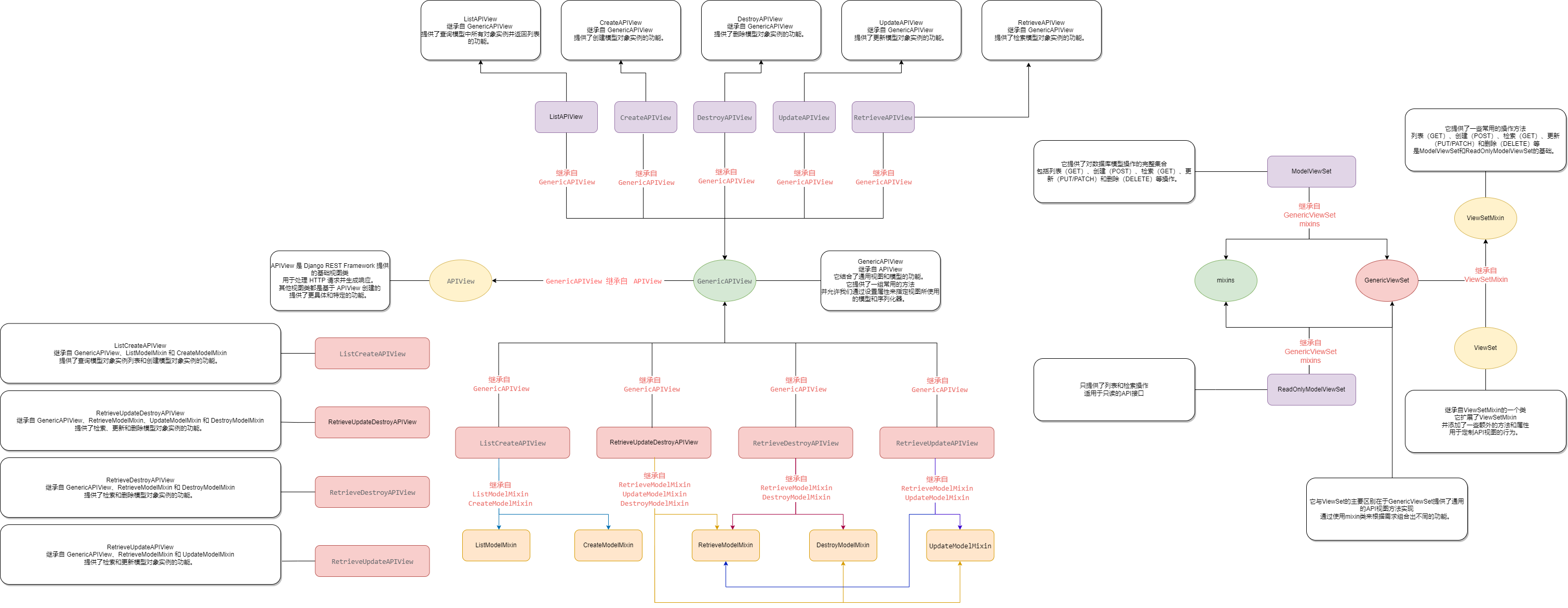
【2】视图类
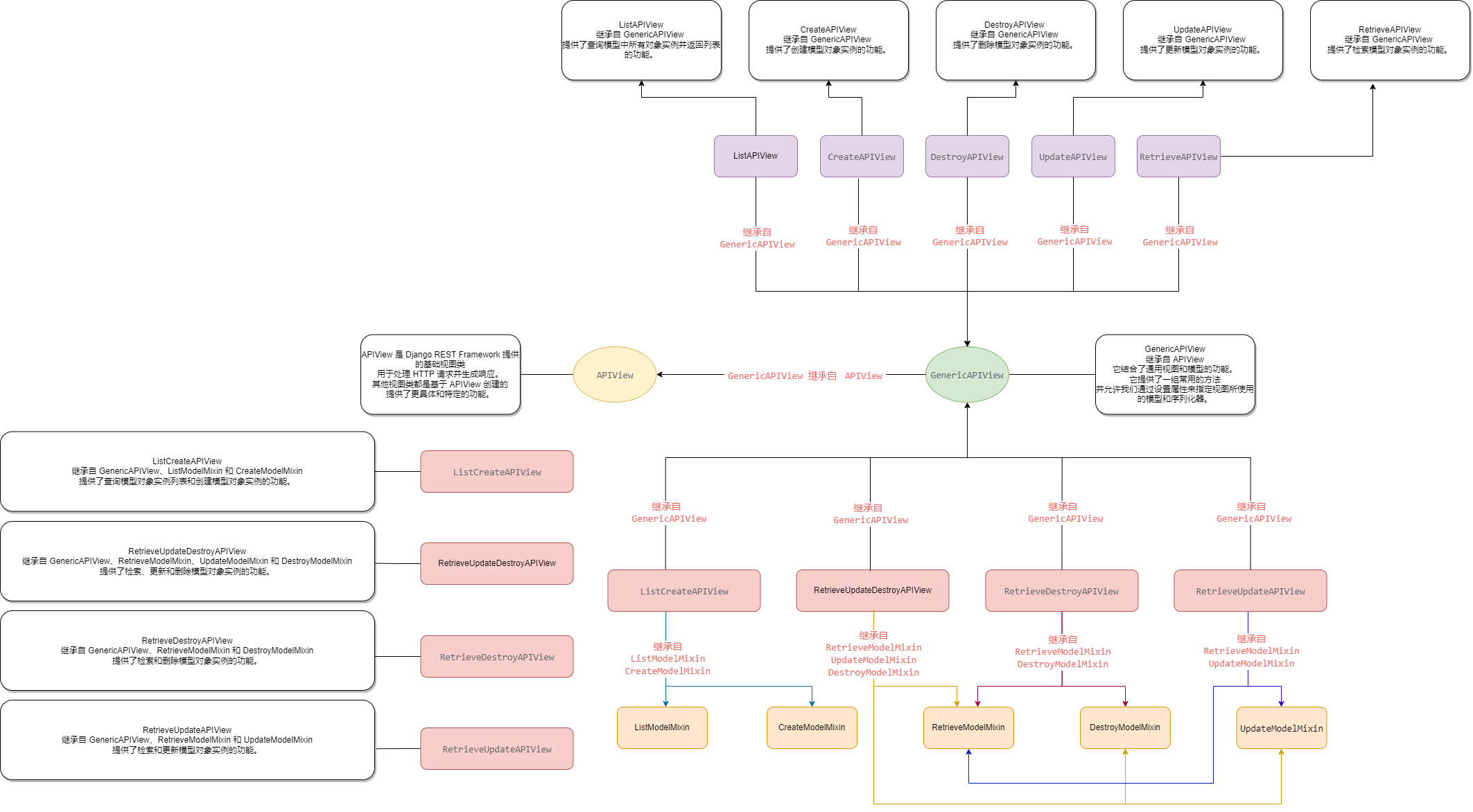
【3】视图集
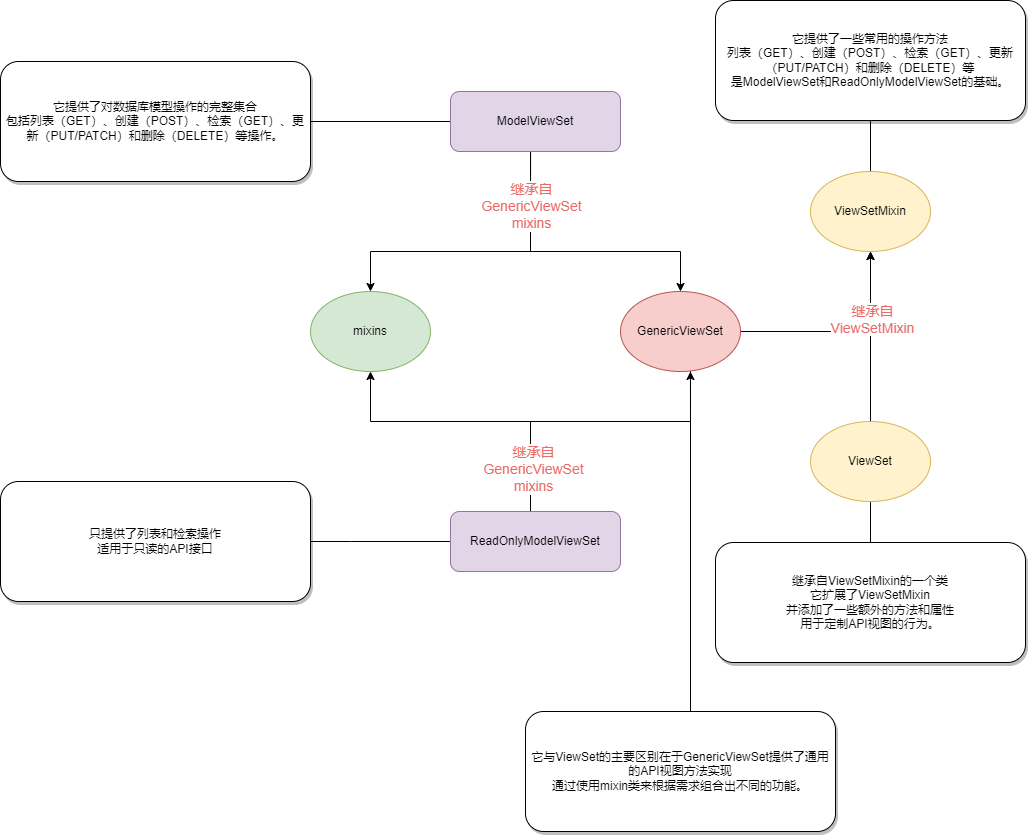
【补充】Python中的Mixin机制
【一】Mixin机制
(1)介绍
-
Mixin是一种在面向对象编程中常用的机制,它通过多重继承的方式实现代码的复用,并且可以灵活地组合不同的功能。
-
在Python中,Mixin通常是一个普通的类,其中定义了一些具有某种功能的方法。
-
Mixin类通常不会单独使用,而是作为其他类的基类,通过多重继承的方式将其功能混入到目标类中。
-
Mixin类的命名通常以Mixin结尾,这是一种命名约定,方便开发者识别。
(2)主要特点
-
代码复用:
- Mixin可以把一些通用的方法封装到一个类中,然后通过多重继承的方式引入到其他类中,从而实现代码的复用。
-
功能组合:
- Mixin类可以通过多重继承的方式,将多个Mixin类的功能组合到一个类中,从而实现更灵活的功能组合。
-
层次结构扁平化:
- 使用Mixin可以避免多层继承带来的层次结构复杂化问题,Mixin类通常只有少量方法,使得继承关系变得扁平化。
-
独立性:
- Mixin类通常是独立于其他类的,即使在没有其他类的情况下,Mixin类仍然是可用的。
(3)注意
-
命名约定:
- 为了避免命名冲突,Mixin类的命名通常以Mixin结尾。
-
方法覆盖:
-
当多个Mixin类中有相同方法名时,子类继承这些Mixin类的顺序会影响方法的调用顺序。
-
一般情况下,最后继承的Mixin类的方法会覆盖之前继承的Mixin类的方法。
-
-
Diamond继承问题:
- 如果在Mixin类之间存在继承关系,并且最终被继承的类同时继承了具有相同方法的Mixin类,那么需要注意方法解析顺序,以避免出现冲突或不确定的情况。
(4)总结
- Mixin是一种通过多重继承的方式实现功能复用和组合的机制。
- 它可以帮助我们在编写代码时更加灵活地应对复杂的需求,并提高代码的复用性和可维护性。
【二】示例
-
当使用Mixin机制时,我们可以通过一个示例来更详细地说明其用法和作用。
-
假设我们正在开发一个图形库,其中包含一些常见的几何图形类,如矩形、圆形和三角形。
-
首先,我们定义一个Mixin类,名为
ColorMixin,用于给图形对象添加颜色功能:
class ColorMixin: def set_color(self, color): self.color = color
def get_color(self): return self.color- 然后,我们定义几个基本的几何图形类,并使用
ColorMixin将颜色功能混入到这些类中:
class Rectangle(ColorMixin): def __init__(self, width, height): self.width = width self.height = height
def area(self): return self.width * self.height
class Circle(ColorMixin): def __init__(self, radius): self.radius = radius
def area(self): return math.pi * self.radius**2
class Triangle(ColorMixin): def __init__(self, base, height): self.base = base self.height = height
def area(self): return 0.5 * self.base * self.height-
在上述代码中,我们将
ColorMixin作为基类,通过多重继承的方式将其功能添加到了Rectangle、Circle和Triangle这几个具体的几何图形类中。 -
现在,我们可以创建具体的几何图形对象,并使用
set_color()和get_color()方法来操作颜色属性:
rectangle = Rectangle(5, 3)rectangle.set_color('red')print(rectangle.get_color()) # 输出: red
circle = Circle(4)circle.set_color('blue')print(circle.get_color()) # 输出: blue
triangle = Triangle(6, 2)triangle.set_color('green')print(triangle.get_color()) # 输出: green-
通过上述示例,我们可以看到Mixin的作用:
- 将一些通用的功能逻辑封装到Mixin类中,然后可以通过多重继承的方式将其混入到我们需要的类中,实现代码的复用和灵活的功能组合。
-
同时,由于Mixin类是独立的,我们可以在需要的时候单独使用它们,而不仅限于在特定的类中使用。
- 这使得我们的代码更加模块化和可扩展。
-
需要注意的是
- 在使用Mixin时,我们需要遵循一些约定和注意事项,如方法命名约定、方法调用顺序等,以避免潜在的命名冲突或方法覆盖的问题。
-
总之,Mixin机制是一种强大的工具,可以帮助我们在面向对象编程中实现代码的复用和功能的灵活组合。
-
通过合理地设计和使用Mixin类,我们可以提高代码的可维护性和可复用性。
支持与分享
如果这篇文章对你有帮助,欢迎分享给更多人或打赏支持!
评论区
